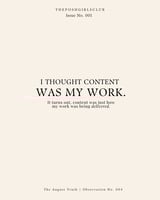
We Call It Starting Over. But We Use Our Old Life as the Measuring Stick.

I’ve been thinking.
We talk about starting over like it comes with a clean slate.
New job.
New relationship.
New business.
New city.
New body.
New version of ourselves.
We say we’re ready for something different.
And then we do something strange.
We use the old life to decide whether the new one is working.
We leave the job and compare every opportunity to the title we had before.
We leave the relationship and compare every new connection to the chemistry we once felt.
We rebuild the business and wonder why it isn’t producing what the old one produced.
We change creatively and immediately look at the numbers from the version of ourselves we supposedly outgrew.
We look at an old photograph and decide that becoming ourselves again means looking like her again.
We call it starting over.
But secretly, we’re demanding continuity.
We want a new life with old proof.
And maybe that’s why starting over can feel so disappointing in the beginning.
Because beginnings rarely look impressive when you compare them to something that had years to become what it was.
A new business cannot compete with the infrastructure of an old one.
A new relationship doesn’t have the memories of a five-year love affair.
A new career doesn’t immediately come with the reputation you spent years building somewhere else.
And the woman you are becoming has not had enough time to show you everything she can do yet.
Still, we compare.
I think part of the problem is that somewhere in adulthood, we stop allowing ourselves to simply become.
When you’re young, becoming is expected.
Nobody looks at a 22-year-old and asks why she isn’t still the person she was at seventeen.
Of course she isn’t.
She lived.
She learned.
She changed.
But the older we get, the more change starts to require justification.
Is the new job better?
Does it pay more?
Is the new relationship healthier?
Are you happier now?
Did the business get bigger?
Did you lose the weight?
Did the move work out?
Was leaving worth it?
We want evidence.
Preferably measurable evidence.
Because numbers make change easier to explain.
But becoming doesn’t always give us numbers.
There is no analytics page that tells you you’re 72% of the way to your next self.
There is no dashboard for discernment.
No quarterly report for self-trust.
No notification that says:
Congratulations. You handled that completely differently than you would have a year ago.
And yet, some of the most important progress in our lives looks exactly like that.
You say no faster.
You recover sooner.
You stop explaining decisions that don’t require consensus.
You recognize patterns before they become problems.
You stop confusing being wanted with being valued.
You stop needing one more conversation to confirm what someone’s actions have already told you.
You become less impressed by things that once distracted you.
You become more protective of things you once gave away too easily.
Your time.
Your attention.
Your access.
Your peace.
None of that photographs particularly well.
It doesn’t always increase your income.
It may not increase your followers.
Nobody sends flowers because you finally developed boundaries.
There is rarely applause when you quietly choose differently.
But that doesn’t mean nothing is happening.
Sometimes the biggest evidence of who you’re becoming is what you are no longer willing to repeat.
I’ve also been thinking about the way we romanticize our former selves.
We remember her confidence and forget what she tolerated.
We remember her body and forget how she spoke to it.
We remember the business when it was successful and forget what it cost us to run it.
We remember the relationship at its most beautiful and conveniently edit out the nights it broke our hearts.
Memory is an interesting editor.
It can turn an entire chapter into a highlight reel.
Then we hold our present life up against it and wonder why today feels insufficient.
Maybe the problem isn’t that we remember.
Maybe it’s that we mistake memory for instruction.
Because I don’t want to erase the woman I used to be.
I actually have enormous respect for her.
She got me here.
She took risks I’m grateful she took.
She survived decisions I wouldn’t make today.
She learned things I now get to call wisdom.
She built skills I still use.
She loved.
She failed.
She tried again.
She figured things out without knowing how they would end.
I don't need to become her again to honor her.
I’m not returning to her.
I’m continuing from her.
There’s a difference.
My old life is evidence.
It is not the benchmark.
It tells me what I have been capable of.
It tells me what I have survived.
It tells me what I know.
It tells me what I never want to learn twice.
But it does not get to dictate what success has to look like next.
Because maybe the next chapter isn’t supposed to outperform the last one.
Maybe it’s supposed to fit better.
Maybe the relationship is quieter but safer.
Maybe the business is smaller but more profitable.
Maybe the career looks less impressive on paper but gives you your life back.
Maybe your circle gets smaller while your relationships get deeper.
Maybe you don't become the woman you imagined ten years ago because you know things now that she couldn't possibly have known.
That isn’t failure.
That’s information.
And maybe that’s the part of starting over we don’t talk about enough.
You are allowed to change the definition of winning.
You are allowed to want something different after finally understanding what the thing you thought you wanted actually costs.
You are allowed to stop chasing a version of success simply because you once announced that you wanted it.
You are allowed to discover that what impressed you at thirty doesn't interest you at fifty.
And you do not owe your former self the life she imagined before she had the information you have now.
Starting over doesn’t mean starting from zero.
You couldn't if you tried.
You arrive carrying everything.
The experience.
The instincts.
The scars.
The skills.
The mistakes.
The taste.
The judgment.
The stories.
The evidence.
You aren't starting from scratch.
You're starting from wisdom.
So maybe the question isn’t:
How long will it take me to get back to where I was?
Maybe it’s:
What can I build from everything I know now?
Because the goal was never to get back.
And maybe the hardest part of becoming isn’t letting go of your old life.
Maybe it’s letting go of the idea that your new life has to outperform it in order to be worth choosing.
I’m not here to tell you what to think. I’m just here to give you something to think about.
XX, Tori.
Maybe this is your Red Lipstick Era.
You don't have to become the woman you used to be.
And you don't have to know exactly who you're becoming before you start choosing differently.
The Red Lipstick Era is for the woman who's ready to trust herself enough to move forward without measuring every new decision against the life she's leaving behind.
Come with me.